On this page
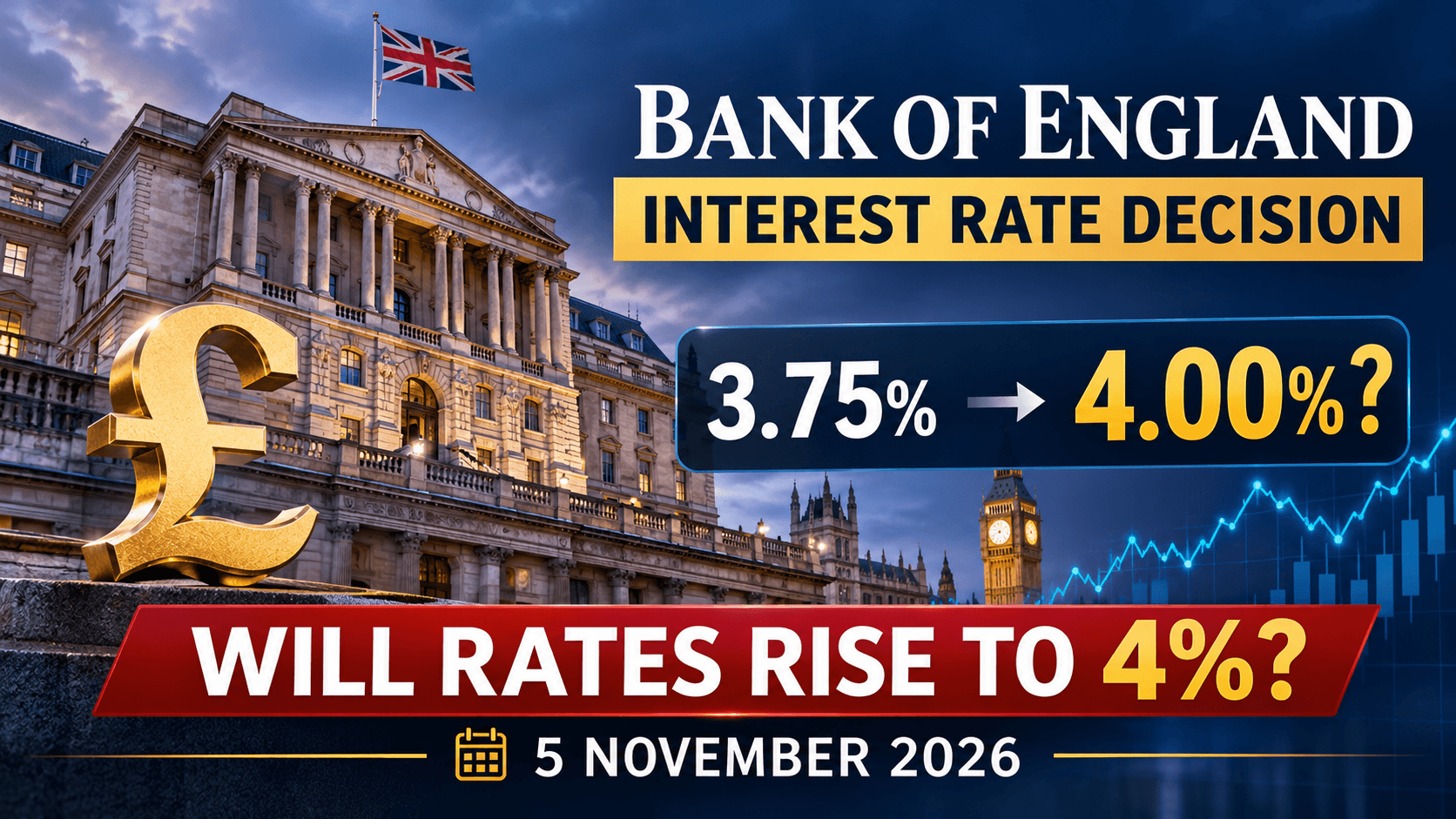
The Bank of England announces its next interest rate decision at 12pm on Thursday 5 November 2026, and most economists expect it to raise Bank Rate from 3.75% to 4%. If it does, it will be the first rise in UK interest rates since 2023, driven by inflation climbing back to 3.5%.
Here is what is expected, why the Bank may raise rates, and what it would mean for your mortgage, savings and bills.
Key takeaways
- Current rate: Bank Rate is 3.75%, where it was held in September.
- Decision time: 12pm UK time on Thursday 5 November, with the Bank's new Monetary Policy Report.
- Expected outcome: a 0.25 percentage point rise to 4%. A Reuters poll found 54 of 63 economists expected a rise.
- Why: UK inflation rose to 3.5% in September, up from 3.1% in August and well above the Bank's 2% target.
- Who feels it first: people on tracker and variable-rate mortgages, whose payments usually rise straight away.
What is the Bank of England interest rate now?
The Bank of England base rate, officially called Bank Rate, is 3.75%. The Bank's Monetary Policy Committee (MPC) held it at that level at its September meeting in a 6–3 vote, with three of the nine members already voting for a rise to 4%.
Bank Rate is the interest rate the Bank of England pays on money that commercial banks hold with it. It strongly influences the rates banks and building societies charge on mortgages and loans, and the rates they pay on savings.
Will the Bank of England raise rates on 5 November?
A rise looks likely, but it is not guaranteed. The evidence points one way:
- Economists: a Reuters poll of 63 economists taken in mid-October found 54 expected an increase to 4%.
- Financial markets: market pricing and prediction markets suggest traders see a rise as close to certain.
- The last vote: three MPC members already wanted a rise in September. Only two more need to switch for a majority.
Some forecasters expect another split vote. Rabobank, for example, expects a 7–2 vote in favour of a rise, followed by a further increase to 4.25% in February 2027. Others, including Oxford Economics, also see a February rise as possible.
Why are interest rates expected to rise?
The main reason is inflation. The Bank of England's job is to keep inflation at 2%, and raising interest rates is its main tool for bringing it down. Higher rates make borrowing more expensive and saving more attractive, which cools spending and, over time, slows price rises.
UK consumer price inflation rose to 3.5% in September 2026, from 3.1% in August. Higher energy prices, linked to tensions in the Middle East, have been a major driver. Economists say price rises in services such as hospitality and rents also remain stubbornly high, which worries the Bank because services inflation tends to be harder to bring down.
What would a rise to 4% mean for you?
Mortgages
- Tracker mortgages follow Bank Rate directly, so payments usually go up within a month or two. On a typical £200,000 repayment mortgage over 25 years, a 0.25 percentage point rise adds roughly £30 a month.
- Standard variable rate (SVR) mortgages often rise too, although lenders decide when and by how much.
- Fixed-rate mortgages do not change until the deal ends. However, new fixed deals are priced on what markets expect rates to do, so many lenders have already raised them ahead of the decision.
If your fixed deal ends in the next six months, it is worth comparing new deals now. Many lenders let you lock in a rate several months before your current deal ends.
Savings
Savers usually benefit from higher rates, although banks do not always pass rises on in full or quickly. Easy-access and variable savings accounts are the most likely to improve. It is worth checking your rate and moving your money if your bank does not keep up.
Loans and credit cards
Rates on new personal loans and credit cards may edge up. Existing fixed-rate personal loans are not affected.
What time is the Bank of England announcement?
The decision is published at 12pm UK time on Thursday 5 November 2026 on the Bank of England website, together with the minutes showing how each MPC member voted and the quarterly Monetary Policy Report with the Bank's latest forecasts for inflation and growth. The Governor usually holds a press conference shortly afterwards.
What to watch in the announcement
- The vote split: a close vote would suggest the Bank is cautious about raising rates further.
- Inflation forecast: how quickly the Bank expects inflation to fall back towards 2%.
- Guidance on future rises: any hint of a further rise in February would move mortgage pricing again.
- Growth outlook: whether the Bank expects higher rates to tip the economy towards a slowdown.
This article was written ahead of the 5 November 2026 decision and will be updated with the result. Forecasts and polls quoted are from Reuters and published economist previews. This is general information, not financial advice.
FAQ
Frequently asked questions
Bank Rate is 3.75%. The Monetary Policy Committee held it at that level in September 2026 in a 6–3 vote, with three members voting for a rise to 4%.
The next decision is announced at 12pm UK time on Thursday 5 November 2026, together with the Monetary Policy Report.
Most economists expect a 0.25 percentage point rise to 4%. A Reuters poll found 54 of 63 economists expected an increase, mainly because inflation rose to 3.5% in September.
For a typical £200,000 repayment tracker mortgage over 25 years, a 0.25 percentage point rise adds roughly £30 a month. Fixed-rate deals do not change until they end.
Usually, yes. Savings rates, especially on easy-access accounts, tend to rise after Bank Rate goes up, although banks do not always pass the full rise on.
To bring inflation back to its 2% target. Higher rates make borrowing more expensive and saving more attractive, which slows spending and price rises over time.
Written by
Mainstream Tech
Newsroom
News and analysis on technology, AI, business, politics and international affairs, from our newsroom in London.
More from Mainstream