On this page
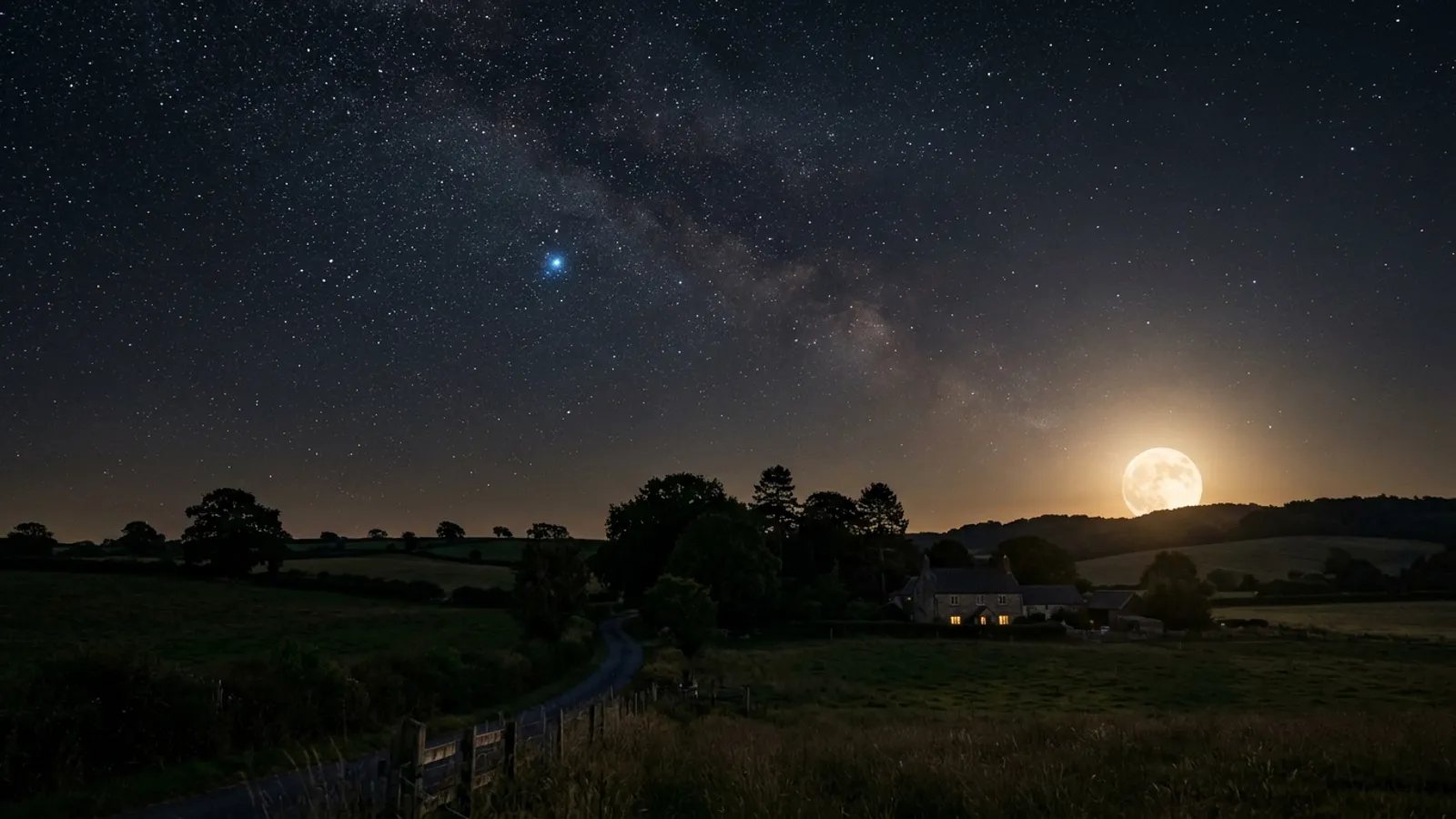
The next full moon in the UK is the Beaver Moon, which becomes exactly full at 14:53 GMT on Tuesday 24 November 2026, the same instant as 14:53 UTC. Time and Date lists it for London as a "Super Full Moon", and Space.com and Star Walk give the same time. The moon is close to the Pleiades, the "Seven Sisters" star cluster, on the evenings of 23 and 24 November.
Next full moon UK: date and time at a glance
| Question | Answer |
|---|---|
| Date | Tuesday 24 November 2026 |
| Exact full moon time | 14:53 GMT (14:53 UTC) |
| Name | Beaver Moon (also called the Frost Moon by the Cree, per Space.com) |
| Supermoon? | Yes, per Sky at Night, Space.com, Time and Date and others |
| Moonrise in London on 24 November | About 15:17, per Star Walk |
| Closest approach to Earth (perigee) | About 21:00 UTC on 25 November, roughly 359,000 km away, per EarthSky |
The UK is on GMT in late November, so there is no clock-change conversion to make: UTC and UK time match.
What time is the full moon in the UK?
The full moon is a precise moment, when the moon sits directly opposite the Sun in the sky. Space.com puts it at 14:53 GMT on 24 November, National Geographic at 2:53 p.m. UTC, and Time and Date at 14:53 London time. EarthSky rounds it to 14:54 UTC, so a one-minute difference between outlets is a rounding choice, not a disagreement.
Nobody in the UK sees the exact moment, because the moon has not risen yet. Star Walk gives a London moonrise of 15:17 on 24 November. Sky at Night describes the moon as rising just before sunset on 23 and 24 November. The moon looks essentially full from 23 to 25 November, so the evening of the 23rd or the 25th works nearly as well as the 24th.
Why is it called the Beaver Moon?
Sky at Night says November's full moon is the Beaver Moon because it is when beavers are busiest preparing for winter. Space.com offers a slightly different explanation, that it rises around the time beavers retreat to their lodges after collecting enough food, and also lists Frost Moon and Digging Moon as names used by the Cree and Tlingit. These are traditional and popular names, not official astronomical terms.
Is it a supermoon?
Sources call it one. Sky at Night says the 24 November full moon is a supermoon, and Time and Date lists it as one. The definition matters, though, because "supermoon" is not a technical term.
NASA says a supermoon occurs when a full moon coincides with the moon's closest approach to Earth, and that "supermoon" is not an official astronomical term. It is typically used for a full moon that comes within at least 90 percent of perigee. The moon is at perigee roughly 30 hours after this full moon, according to EarthSky's timing (our arithmetic from the two times).
Where sources disagree is the count:
- Space.com and EarthSky call it the first of four supermoons in a row.
- National Geographic describes a streak of three, with this one first.
- Sky at Night calls it the second supermoon of 2026, after January's Wolf Moon, and Star Walk says it is the first since January 2026.
The "first or second" difference is about whether you count January, and the "three or four" difference is about how many later full moons pass the cut-off. Analysis: with no official threshold, outlets draw the line in different places, so it is safest to say this is widely classed as a supermoon rather than quote a streak number as settled.
How much bigger does it look? Star Walk says about 6.5% larger and 13.5% brighter than a full moon at the average Earth-Moon distance. Space.com, citing NASA, says a supermoon can look about 14% larger and 30% brighter than the year's smallest full moon. These compare against different baselines, so they do not conflict. Star Walk and Sky at Night both note the difference is hard to see with the naked eye.
What is the supermoon and Pleiades meeting?
The Pleiades (also called M45 or the Seven Sisters) sit in Taurus. EarthSky says the supermoon passes the cluster on the evenings of 23 and 24 November, and that the glare will make the cluster hard to see. Its tip is to hide the moon behind the edge of a building. Star Walk puts the moon's conjunction with Alcyone, the cluster's brightest star, at about 12:05 UTC on 24 November, with a separation of about 0 degrees 57 arcminutes. That is daytime in the UK, so the best UK view comes after the moon rises.
Sky at Night describes the layout differently for each night. On 23 November the Pleiades and the Hyades are below and to the left of the moon. On 24 November the moon sits between the two clusters. National Geographic also says the Pleiades will be near the moon on the 24th.
Star Walk says the moon may pass in front of individual Pleiades stars from some regions, including parts of East Asia, the Pacific and North America. It does not list the UK among them, so UK observers should expect a close pairing rather than a star disappearing behind the moon. Binoculars, per Star Walk, can help.
Why is the next full moon special?
Three things combine. It is a supermoon, it sits beside one of the sky's best-known clusters, and it is the start of a run of closer full moons, whichever way the count is made. Sky at Night also lists a lunar occultation of the Beehive Cluster (M44) on 28 November, from around 21:40 UTC, and says Uranus is at opposition on 25 November between the Pleiades and Hyades. For another recent space story, see our report on the Voyager 1 one light-day milestone.
Sources
- Time and Date: moon phases, London
- Space.com: November full moon 2026
- Star Walk: Beaver Supermoon, November full moon 2026
- EarthSky: November full moon
- National Geographic: a rare streak of supermoons
- Sky at Night Magazine: November 2026 stargazing
- Sky at Night Magazine: the Super Beaver Moon
- NASA: supermoons
FAQ
Frequently asked questions
The next full moon is the Beaver Moon on Tuesday 24 November 2026. It is exactly full at 14:53 GMT, which is also 14:53 UTC. It rises in London at about 15:17 that afternoon, according to Star Walk.
The exact moment of full moon is 14:53 GMT on 24 November 2026. Because the moon has not risen in the UK at that moment, look east after sunset on 23, 24 or 25 November, when it appears essentially full.
It is the Beaver Moon, the traditional name for November's full moon. Sky at Night says the name reflects beavers preparing for winter. Space.com also lists Frost Moon and Digging Moon as other names used by the Cree and Tlingit.
It is widely described as a supermoon, because the moon reaches its closest point to Earth about 30 hours later, and it passes close to the Pleiades star cluster. NASA notes that supermoon is not an official astronomical term. Sources disagree on whether it is the first of three or four in a row, or the second supermoon of 2026.
Spotted an error? Tell us. Read how we report and correct stories in our editorial policy.
Written by
Mainstream Tech
Newsroom
News and analysis on technology, AI, business, politics and international affairs, from our newsroom in London.
More from Mainstream